mm-news-@dmin
 The eclipse will reach its peak at 11:12pm and total phase will end at 11:53pm
Skywatchers in Pakistan will be able to witness the “Blood Moon” during a total lunar eclipse tonight.
According to the Pakistan Meteorological Department (PMD), the rare celestial event will be visible across the country.
The phenomenon will also be observable in Europe, Asia, Australia, Africa, as well as North and South America.
The moon’s brightness will begin to dim at 8:28pm (PST) on September 7. The partial eclipse will commence at 9:27pm, followed by the start of the total eclipse at 10:31pm.
The eclipse will reach its peak at 11:12pm and the total phase will end at 11:53pm. The partial eclipse will then continue until 12:57am. While the event will come to a complete end at 1:55am on September 8.
People in Asia, including India and China, will get the best view of Sunday’s total eclipse. Which will also appear in eastern Africa and western Australia.
Later in the month, on September 21 and 22, the year’s second and final partial solar eclipse will occur. It will be visible from southern parts of Australia, the Pacific Ocean, the Atlantic Ocean and Antarctica.
Stargazers in Europe and Africa will get a brief chance to see a partial lunar eclipse. Just as the Moon rises during the early evening, while the Americas will miss out.
The Moon appears red during lunar eclipses. Ryan Milligan said the only sunlight reaching it is “reflected and scattered through the Earth’s atmosphere.” An astrophysicist at Northern Ireland’s Queen’s University Belfast.
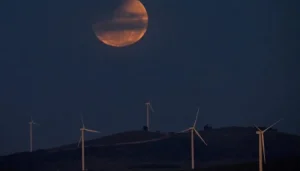 A lunar eclipse turns the Moon red near the Australian capital city of Canberra on March 14, 2025.
He told AFP that blue wavelengths of light, being shorter than red ones, disperse more easily as they travel through Earth’s atmosphere.
“That’s what gives the moon its red, bloody colour.”
While special glasses or pinhole projectors are needed to safely observe solar eclipses, all that is required to see a lunar eclipse is clear weather — and being in the right spot.
The last total lunar eclipse was in March this year, while the one before that was in 2022.
Milligan, a self-described “solar eclipse chaser”, said he considered Sunday’s event a prelude to what he called the “big one” next year.
A rare total solar eclipse, when the Moon blocks out the light from the Sun, will be visible in a sliver of Europe on August 12, 2026.
For more than a decade, Milligan has travelled the world to witness 12 totalities, which is when the Moon completely obscures the Sun.
Next year’s totality — the first in mainland Europe since 2006 — will be visible only in Spain and Iceland, though other countries will be able to see a significant partial eclipse.
In Spain, the totality will be visible in a roughly 160-kilometre (100-mile) band between Madrid and Barcelona, but neither city will see the full phenomenon, Milligan said.
It will be the first total solar eclipse since one swept across North America in April 2024.