mm-news-@dmin
 Israel says it will continue the war until it destroys the Palestinian resistance group.
Two years of Israeli bombardment of Gaza has piled grief upon grief for displaced Palestinian Inas Abu Maamar.
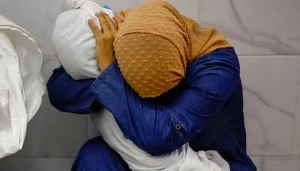
In the first days of the war, a Reuters photograph showed Abu Maamar stricken in a hospital morgue, cradling the shrouded body of her five-year-old niece Saly.
Since then, Israeli airstrikes and tank shells have killed many of her close relatives and left her bereaved, hungry and homeless, caring for her orphaned young nephew.
Israeli Prime Minister Benjamin Netanyahu has embraced a plan by US President Donald Trump for Gaza, and Hamas has partially accepted it, but there is no certainty over when or whether the plan will end the war.
All previous efforts to halt the conflict since Israel began its offensive after October 7, 2023.
Israeli airstrike killed young niece
An Israeli missile killed Saly when it struck the family home in Khan Younis in southern Gaza.Reuters photographer Mohammed Salem found Abu Maamar embracing her body at the Nasser Hospital morgue in Khan Younis on October 17, 2023.
The blast also killed Abu Maamar’s aunt and uncle, her sister-in-law and her cousins, as well as Saly’s baby sister Seba. This summer, Israeli fire killed Saly’s father and her brother Ramez while they were bringing food back to the family.
Local health authorities say Israel’s military campaign in Gaza has killed more than 67,000 Palestinians. They believe thousands more lie dead under the rubble but have not yet been counted in the official death toll.
“The war destroyed us all. It destroyed our family, destroyed our homes. It left pain and loss in our hearts,” said Abu Maamar, who is now 38.
Israel launched its offensive for the attack exactly two years ago in which Hamas gunmen burst through border defenses from Gaza, killed about 1,200 people and dragged another 250 back into the enclave as hostages.
Israeli Prime Minister Benjamin Netanyahu has said he will pursue the war until the Palestinian resistance group has been destroyed, and the army has intensified its campaign by pushing again into Gaza City in the north.
The Israeli military says it tries to avoid civilian casualties but strikes at Hamas wherever it sees members of the group emerge, accusing the group of hiding among the civilian population. Hamas denies that.
Life is tough in crowded tent encampment
Abu Maamar and her remaining relatives have fled waves of Israeli bombing and ground incursions several times over the past two years and are now living in a crowded tent encampment on bare sand near the beach.
Conditions are harsh. Sickness is rife. Food and clean water are scarce. Israeli bombardments terrify the traumatised population.
Abu Maamar’s greatest concern is for her nephew Ahmed, the son of Ramez and younger brother of Saly.
Having lost his mother, both sisters and maternal grandparents 10 days into the conflict, he lost his father and paternal grandfather when they were killed while fetching food in June after it had run out the previous day, Abu Maamar said.
“His father would take him around, play with him, take him to the beach, take him around to see his aunts,” Abu Maamar said of her nephew.
“His life really changed now. He’s in the tent 24 hours (each day),” she said.
After his father’s death, Ahmed spent a lot of time with a cat he named Loz. The cat died in August, Abu Maamar said.
Concern that the war is not about to end
When Reuters interviewed Abu Maamar a year ago, she said she was “waiting for the cascade of blood to stop”.
She is still waiting, and fears the latest moves to end the war will fail unless Trump puts more pressure on Israel.
“It is enough for us. What we lost is enough. We lost many of our loved ones. We left (our homes) with them, and we will return without them,” she said on Sunday.
“My only fear is for the war to continue. We do not want it to continue. We want it to end once and for all.”